After several weeks of arduous production, the audio book edition of Heart Of Diamonds is available online. Now you can listen to the exciting story of Valerie Grey's struggle to reveal a diamond-smuggling scheme that threatens to plunge the Congo deeper into war--dragging the United States along with it. The production is complete and unabridged, with nearly eleven fast-paced hours of narration.
Heart Of Diamonds--now available in trade paperback, eBook, and audio book editions.
Dave Donelson, author of Heart of Diamonds a romantic thriller about blood diamonds in the Congo.
Saturday, March 6, 2010
Heart Of Diamonds Now A Free Audio Book


Monday, February 22, 2010
Umuntu ngumuntu ngabantu
"Umuntu ngumuntu ngabantu" should be repeated every hour on the hour by every school child all over the world until it becomes the mantra of all societies. It is Bantu for "A human is human because of other humans."
The simple but profound adage is the theme of Chinua Achebe's collection of essays, The Education of a British-Protected Child: Essays.
"Our humanity is contingent on the humanity of our fellows. No person or group can be human alone. We rise above the animal together, or not at all. If we learned that lesson even this late in the day, we would have taken a truly millennial step forward."Achebe, winner of the Man Booker International Prize and best known as the author of Things Fall Apart,
 one of the seminal works of African fiction, has a subtle, dry voice that makes each of these seventeen essays something to savor and linger over. He makes his points about racial stereotypes, African development, history, and politics, and the African-American diaspora, sometimes with humor, sometimes with biting directness, but always graciously and without rancor. You sense Achebe knows that to rail against injustice is futile; change must come through education achieved one cogent argument at a time.
While Achebe is a scholar, he is also a master storyteller. More often than not, he makes his points not with dry logical argument but with an exegetical tale about someone he's met or something that's happened to him. Those little narratives are much more illustrative than pure cant. In "Spelling Our Proper Name," he tells the story of Dom Afonso of Bukongo, for example, who negotiated with King John III of Portugal in 1526 as an equal. He then writes:
"Such stories as Dom Alfonso's encounter with Europe are not found in the history books we read in schools. If we knew them....young James Baldwin would not have felt a necessity to compare himself so adversely with peasants in a Swiss village. He would have known that his African ancestors did not sit through the millennia idly gazing into the horizon, waiting for European slavers to come and get them."I found his exploration of the complex politics and history of Africa in "Africa's Tarnished Name" to be particularly thought-provoking. He also talks frequently about Joseph Conrad's purported racism, which has become an important theme in the deconstruction of Heart of Darkness. Some of these essays have been presented elsewhere, although they have been revised and updated since they were first published. Nothing in them is dated, however, and Achebe's insightful discussions with Langston Hughes and James Baldwin ring as true as his observations about the potent symbolism of Barack Obama's election as President of the United States.
Dave Donelson, author of Heart of Diamonds a romantic thriller about blood diamonds in the Congo.
Saturday, February 13, 2010
Caped Crusaders In The Stacks - A Love Song For Librarians

 Marilyn Johnson has accomplished one of the most difficult tasks a journalist can attempt: she accurately portrayed change in the midst of it happening. In This Book Is Overdue!: How Librarians and Cybrarians Can Save Us All
The major change agent in the field is the same one rocketing through the rest of our society, technology. Johnson's singular accomplishment was to describe the impact of that many-headed monster with a minimum of jargon and a maximum of humaneness. She did it not by focusing on bits and bytes, industrial statistics and professional arcana, but by presenting the human side of technology; how librarians are adapting (or not) to their new tools, defending their jobs (or not) against the onslaught of automation, and even inventing (or avoiding) new roles in their communities for their cherished libraries. Her eye was on the people, not the machines.
First and foremost, Johnson is a storyteller. Like the good magazine journalist she was in her prior career, she uses people to tell her story of cyber assault on the stacks. Each chapter explains the lives--personal and professional--of outstanding, devoted, and often off-beat librarians. Yet she never strays from the theme of the book, which is that librarians are the people who can "Save Us All" from drowning in the digital ocean. Among the many tales she tells is the one about Kathy Shaughnessy, the Assistant Professor/Instructional Services Librarian at St. John's University Library in Queens who leads a team teaching computer skills to students from a wide variety of countries at the University's campus in Rome. The goal: to enable the students, some of whom had never touched a computer, to return to their native land and complete their master's degree online. In another, she lavishes praise on David Smith, the storied reference librarian at NYPL who retired in 2009 after a career devoted to helping writers use the institution's vast resources to their best effect. In the process, she tells us not only what Smith accomplished, but gave us an accurate picture of what's happening to the home of Patience and Fortitude (the stone lions that guard the library) as it plunges headlong into the digital age.
Johnson also tells the disturbing story of the near-debacle that happened when the Westchester Library System installed new catalog software to serve 37 of its 38 member libraries. Her account has two viewpoints, that of the librarians struggling with the new system and the one of the IT director trying to make it work. There is A LOT OF TENSION in the story. Full disclosure: I was president of the WLS Board at the time and witnessed the events firsthand. Trust me, Johnson's account is distressingly accurate.
It would be easy to get lost and start wandering in the electronic landscape, but Johnson generally steers clear of that danger. The only time her compass went a little haywire was in her chapter on libraries in Second Life, the virtual world constructed by people with an apparently limitless amount of time on their hands. Admittedly, my opinion of the whole enterprise probably clouds my viewpoint, which matches that of Johnson's husband, Rob, whom she quotes as observing, "Yes, yes, but what's it for?"
Even during her foray into Second Life, though, Johnson's exuberance carries the narrative. Her enthusiasm for the topic and her obvious love for the subjects of her tales--the librarians she hung out with for three years while researching the book--are evident on every page. This Book Is Overdue is just what the title says, a long-overdue love song to librarians.
Dave Donelson, author of Heart of Diamonds a romantic thriller about blood diamonds in the Congo.
Sunday, January 10, 2010
Heart Of Diamonds Promotes Congo Aid Groups
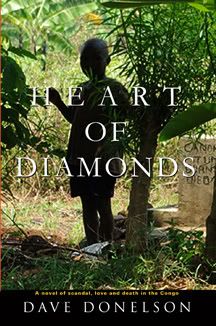
Most significantly, perhaps, the new edition recognizes four organizations whose work helps the people of the Congo. A couple of these organizations are large, the other two are small, but the work they all do contributes to the well-being of the citizens of the Democratic Republic of Congo.
HEAL Africa
Women For Women International
Georges Malaika Foundation
Doctors Without Borders
The new edition of Heart of Diamonds is available from the publisher or Amazon.com. You can also find (or order it) from your favorite local bookseller. If in doubt, use the ISBN 9781449919924.
Do you prefer e-Books? You can now put the new edition of Heart of Diamonds on your Kindle, Sony Reader, Stanza, Palm, or just about any other e-Book reader with just a couple of clicks.
Check your favorite online bookseller, or go to Smashwords.com for a comprehensive listing of available versions. For the Kindle edition, visit Amazon.com.
Dave Donelson, author of Heart of Diamonds a romantic thriller about blood diamonds in the Congo.
Sunday, December 20, 2009
New York Schools Lose To Empire City Casino
While New York’s schools are scrambling to replace state aid that’s being withheld by Governor David Paterson and anticipating even bigger shortfalls in funding for next year, a little-noticed change in a formula in the regulations covering Empire City at Yonkers Raceway is taking even more money out of their budgets. It’s part of a bailout just like those that Washington used to save Wall Street banks, multinational insurance companies, and Detroit automakers. But Washington didn’t step in to rescue the casino—this particular $56,000,000 bailout was funded by New York’s school children.
Even without the bailout, the casino has generated some exceptionally good income for the Rooney family, owners not only of the Yonkers Raceway and Empire City Casino but also of the six-time Super Bowl Champion Pittsburgh Steelers. Before I get into some mind-boggling numbers, a little background might be helpful. Empire City, the home of what must be one of the world’s largest collection of 25-cent slot machines (more than 5,000 coin guzzlers of all denominations), opened in October 2006, five years and many lawsuits after the New York legislature authorized it. Advocates of video gaming pointed to the economic boon it would bring to the city and their arguments eventually won the day.
Today, thousands of gamblers flock to Empire City from Westchester, the Bronx, and beyond, filling the 5,000-car parking lot and streaming off buses from Long Island, Queens, and Northern New Jersey. There seems to be a crowd at any time of the day or night, a mix of the under-employed, the over-worked, retirees, guys with dates, gals in groups, butchers, bakers, and candlestick makers, all looking for a little escape and a chance to stick their hand in the pot of gold at the end of the rainbow. According to Empire City General Manager Robert Galterio, the average visitor spends $75 in the casino, less than the cost of a ticket to a Broadway play or two tickets in the cheap seats at the new Yankee Stadium.
Empire City is certainly a major contributor to the local economy. The casino and track is Yonkers' biggest single taxpayer and largest private employer with 1,250 on staff, up from about 300 in 2005 before the casino opened. The annual payroll is now about $30 million and the majority of the employees are from lower Westchester and the Bronx.
Here’s the mind-boggling part: in the fiscal year ending in March 2009, Empire City raked in nearly $500 million dollars after paying off the winners. Of that, the Rooney family kept about $212 million, which they used to cover operating expenses, marketing, and debt service on the $285 million construction cost of the facility. While they don’t reveal net profits, Galterio doesn’t deny that there’s plenty left over.
The state education fund comes out a winner, too, since it receives a big chunk of all gaming in New York as part of the incentive for communities to allow the casinos and lottery to operate. In the 2008/09 fiscal year, though, the state’s school children did without a cool $56 million less than they should have received because the share of casino profits allocated to the education fund was cut as part of a bailout of Empire City engineered to help them meet mortgage payments and increase the amount spent on marketing the casino and racetrack. The loss in the current fiscal year will be the same if not larger. The original formula included in the legislation authorizing the establishment of the casino called for nearly 59% of the “Net Win” from the gaming machines (the amount lost by bettors) to go the state education fund. Under the new formula approved by the state legislature, that share became 44%, with the difference going to the casino operators.
Galterio explains that the formula was temporarily corrected to adjust for a planning error. He said all the studies done to arrange construction financing for the facility proved to be grossly optimistic. "In the summer of 2007, our lenders came down pretty hard on us and our interest rates went up," he says. "We borrowed $285 million to do the job, and our interest expense went up to $30 million per year." Without that big interest payment, he says, the operation would be profitable. That shortfall was covered by reducing the amount sent to the state education fund.
This year’s casino revenue grew as a result of another change in the formula. The amount allocated to marketing was doubled, again at the expense of the education contribution. "They allowed us to promote more, to advertise more, do better marketing, increase direct mail, do a lot more promotions and contests on the property," Galterio explains. He also said that the company is now allowed to use those funds to promote the racetrack as well as the casino.
The idea was that more advertising would increase the revenue, which would pay off in the long run with more dollars for everyone, including the education fund. Play has indeed increased, with average revenue per machine per day growing substantially this fiscal year so far. While the distribution formula phases back to the original levels starting in 2010 (unless there's another bailout), the education fund will be short-changed in the meantime, although it will receive some benefit from the additional marketing. For the April-November, 2009, period, the casino's "Net Win" is up about $47 million over the same period last year. Of that increase, $17 million went to the schools, which is nothing to sneeze at. Under the old formula, though, the state education fund would have received $43 million more at a time when it sorely needs it.
In all fairness, it should also be pointed out that the "lost" funding for schools wouldn’t exist in the first place if the casino hadn’t been opened. And the City of Yonkers receives about $20 million which goes to the city's schools. Still, Empire City’s owners seem to have profited most from the latest deal. If the operation was profitable before the interest rates increased, it must be considerably more so now that their entire interest expense is covered—-and then some—-by the shift in fund distribution away from schools and into their coffers.
The bargain is one that NY State Assemblyman Mike Spano of Yonkers had no trouble supporting. He and Assemblyman Gary Pretlow of Mount Vernon sponsored the legislation. "This is the big kahuna," Spano says. "The biggest beneficiaries of that track are Yonkers and the state of New York. No one wants to see it falter. It is imperative that that track operates and thrives and continues to do well."
The school children? Their well-being is apparently not quite so imperative.
Dave Donelson, author of Heart of Diamonds a romantic thriller about blood diamonds in the Congo
Monday, December 14, 2009
Call For Support For Westchester Libraries
It's budget crunch time in Westchester, which means it's time to review the importance of libraries to our way of life. Following is some information I sent recently to my county legislators.
Westchester County funding support many of the services the Westchester Library System provides to our 38 members libraries and the 480,000+ Westchester citizens who have library cards. I venture to say that the 7.5 million visits paid to Westchester’s libraries annually exceeds public use of just about any other institution in the county. County support is vital in providing the services that make those libraries important contributors to our economy and our way of life.
Here are some of the WLS functions funded in whole or in part by the county:
Central Catalog of 5.4 million items. We expect to add 280,000 listings in 2010, handle 850,000 “holds” for patrons, and continue to expand El Catalogo En Espanol, our unique service for this growing portion of the Westchester community. By supporting the Central Catalog instead of expecting each library to provide its own catalog, the county not only provides an essential service to library users, but saves local libraries hundreds of thousands of dollars annually.
Inter-Library Loan Service delivering 2.8 million items. This county-funded program enables local libraries to purchase fewer items for their individual collections while still giving patrons access to a wide range of materials. Through WLS, the cost per delivery transaction is only eighteen cents.
WLS IT Services provides maintenance and support (not to mention centralized purchasing) for over 1,000 computers at member libraries. The free public Internet access enabled by this service is essential to job-hunters, students, and others with limited or no Internet access at home.
The WLS WEBS Education and Career Counseling provides employment counseling for over 3,000 Westchester job seekers in programs held at member libraries.
The WLS Health Advocacy Resource Centers assists 2,800 senior citizens (and others) navigate health insurance and services.
All of these programs and services contribute to the economic well-being of Westchester County, which is but one compelling reason for continued support in the county budget. In addition, of course, our quality of life is greatly enhanced by the libraries in our communities. This year, for example, over 43,000 children attended more than 2,650 programs at member libraries and read more than 557,000 books as part of the Summer Reading Program. Westchester librarians answer some 1.6 million reference inquiries each year.
As economic hardships press upon them, we can only expect Westchester’s citizens to turn more and more to their local libraries for help finding jobs, learning new skills, improving their business operations, managing their health care expenses, and dealing with the vicissitudes of today’s economy.
The generous support provided in past years by Westchester County has helped WLS and its member libraries meet the demands of the county’s citizens in an efficient, cost-effective manner. I urge the County Legislature to continue that support in the 2010 budget year.
Dave Donelson, author of Heart of Diamonds a romantic thriller about blood diamonds in the Congo
Sunday, December 13, 2009
Insightful Interview of Christiane Amanpour
My colleague Rima Abdelkadar recently interviewed journalist Christiane Amanpour about her new program on CNN. I was particularly intrigued by Amanpour's thoughts on the difference between fact-based reporting and commentary that's passed off as news by many voices in both old and new media. Her thoughts on why Americans don't get intelligent news coverage of international affairs are spot on.
Dave Donelson, author of Heart of Diamonds a romantic thriller about blood diamonds in the Congo
Tuesday, December 1, 2009
Can Votes Save The Third World?

Paul Collier, professor of economics at Oxford and Director for the Center for the Study of African Economies, contends that our obsession with democracy as the be-all and end-all of governance for every nation in the world is a big mistake. He points out that voting is good but far from a panacea for developing countries who lack the social structure, legal systems, stability, and economic prospects to make the results of their elections work. Collier's contentions aren't based on guesswork, either, but rather on statistical studies that examine not our beliefs about developing countries but the reality of them.
I was particularly intrigued by his comments about the Democratic Republic of Congo, which provides numerous examples of the situations he explores. Here's one passage that neatly sums up the current status of the legitimate Congolese mining industry:

"Is democracy the key to peace in these societies?....The recent record is not entirely encouraging....
"Take the transitional government of the Democratic Republic of Congo. Knowing that they had only three years in power before facing elections and the possible loss of office, ministers set about plundering the public purse. But the public purse was pretty small because tax revenue had withered away: as you will see, low taxation is part of the strategy of misgovernance. But plunder can extend beyond tax revenue. One strategy would be to borrow: saddle future citizens with liabilities and run off with the proceeds. Unfortunately for the new leaders of the DRC, this strategy was not feasible: President Mobutu had already used it to the hilt so that the country was beyond its neck in debt. No bank was going to lend.
"But there was an alternative. The Congo is mineral-rich. Much of these resources are unexploited because under President Mobutu it would have been folly for a company to incur investment necessary to sink a mine. The president was stuck in what economists call the time-consistency problem: because he could not bind himself from confiscating investments, no sane company would make them. But by the time of the transitional government the global boom in commodity prices had changed the calculus of risk: it was worth paying a little something for the exploitation rights that the transitional government could legally confer. And so the ministers of the transitional government of the DRC mortgaged the future of its citizens as surely as if they had issued debt, by selling off national assets at bargain prices. A few months ago I had lunch with one of the shrewd purchasers of these rights: a good lunch it was too. He became a little upset when I told him that the rights ought to be renegotiated."
While I found most of Collier's observations highly believable, I can't say the same for his proposed solutions, which I found mostly impractical or even totally impossible except in theory. Still, the solutions he proposes are like the rest of the work--very tasty food for thought.
Dave Donelson, author of Heart of Diamonds a romantic thriller about blood diamonds in the Congo.
Friday, November 13, 2009
Two Great Library Events
I had not one but two gratifying library experiences yesterday.
The first occurred in my tiny local library in West Harrison, NY, a place I often go to clear my head after I've finished writing for the day. As I sat reading a newspaper, I couldn't help but overhear an older gentleman tell the desk clerk he would like to get a library card for his nine-year-old grandson. I idly looked up to see the man standing at the desk, the boy beside him ogling the DVD rack next to them. The librarian explained the simple form and showed the grandfather to a table near me to complete the paperwork while she gave the boy a brief tour of the library.
When the grandfather finished filling out the application, he glanced at me and our eyes met. I smiled and nodded. He did the same and said, "It's a great day, isn't it?"
I looked out the window at the cold, gray rain that had been falling all day, then turned back to him just as his grandson came up to the table with an armful of books and videos. "Yes it is," I answered. "It's a great day."
A few hours later, I had a gratifying library experience of a different kind. It was the Fiftieth Anniversary Celebration and Annual Meeting of the Westchester Library System, a consortium of 38 public libraries serving Westchester County, NY. While I knew this was a special occasion, I was astounded by the turnout: well over 200 library lovers packed the venue!
In addition to the WLS staff and trustees (myself included), there were dozens of library directors and staff members, friends' groups, board members, and just plain folks who had gathered to show their love of libraries and the people who make them possible. Even though election day was more than a week past, we even had an impressive array of county and state legislators. It was truly heart-warming to see a diverse group of this size gathered for such a cause.
Three awards were given out by WLS Director Terry Kirchner and Board of Trustees President Patricia Fontanella. The Service Award was presented to Jean Reidy, nominated by the Somers Public Library for her years of dedication to the library community. The Support Award went to The Friends of the North Castle Public Library, which sponsors the fabulously successful Armonk Outdoor Art Show each year, raising thousands and thousands of dollars for the library. The Innovation Award was presented to Greg and Pat Keenan, owners of the Uno Chicago Grill in White Plains. They came up with a weekly--free--pizza party to reward young readers that has been hugely successful.
The program also included several pertinent speakers including Bill Ryan, President of the County Board of Legislators, Mitch Freedman, WLS Director from 1982-2005, and Siobhan Reardon, WLS Director from 2005-2008 and now President and Director of the Free Library of Philadelphia.
The keynote address was by Marilyn Johnson, author of This Book Is Overdue!: How Librarians and Cybrarians Can Save Us All
and The Dead Beat: Lost Souls, Lucky Stiffs, and the Perverse Pleasures of Obituaries (P.S.)
As Marilyn spoke about the magic that happens in libraries, I couldn't help but think of the small bit of magic I'd seen earlier in the day when the boy and his grandfather came for the first time to the West Harrison Library. Like every day, yesterday was a great library day.
Dave Donelson, author of Heart of Diamonds a romantic thriller about blood diamonds in the Congo
Tuesday, November 3, 2009
Insurance Companies Have A Lot Of Gall
As Congress continues to flip-flop like a beached mackerel over the public insurance option and health care reform, I received notice today of my new health insurance rates for 2010. The increase was enough to give me heart failure, but I stopped and pulled myself together when I realized I really couldn’t afford to get sick right now. Taking deep, calming breaths and trying to think happy thoughts, I did the math just to make sure I wasn’t hallucinating. I can’t afford mental health care, either.
Yep, I was right. The increase in my premiums for next year is a smooth 18%. Thank goodness I didn’t have any serious illness this year…can you imagine how much my rates would have gone up if I’d had any claims? At least I can get insurance, unlike a whole bunch of other Americans who can’t afford it or are too sick to get coverage.
Maybe my insurance company is struggling, I thought. Maybe they are on the brink of collapse, a disaster that would be precipitated by competition from the public insurance option they so vehemently oppose. They are publicly traded, so that information is pretty easy to find. Next step: the financials.
How about that? 2009 quarterly revenues for the first nine months are substantially ahead (+7.6%) of the same period last year, which was up from 2007, which was up from 2006, which jumped substantially over 2005 (due to an acquisition), which was up from…..you get the picture. Earnings per share aren’t bad either, increasing 35% for the first nine months of this year from the same period in 2008. Guess their health isn’t so bad.
While the insurance companies continue to block the public option and Congress continues to cater to them, though, my heath is deteriorating fast. Deep breaths...deep breaths...deep breaths.
Dave Donelson, author of Heart of Diamonds a romantic thriller about blood diamonds in the Congo


 Posts
Posts


