The human body hasn’t changed for millennia, but the place where we strengthen, shape, maintain, and tone our bodies certainly has. And how.
Today, more and more of us do our crunches, push-ups and bicep curls at home—and not in the corner of the bedroom, either, or in our dark musty basement. Today’s home gym is light and airy, well equipped and welcoming, and above all, a place where you want to go to get the healthy body you desire.
But do you really need to design a space to sweat? Of course not, but you don’t really need to design a place to cook, either, as long as you’re content with a pile of burning wood and a hunk of meat on a stick. A little help with investing thousands of dollars in the right exercise equipment and some thought on the ambience of the place where you’ll be using it will improve your results.
Plan Around Your Workout
So how do you get started? The first step, says Ruth Tara, owner of Home Gym Designs in White Plains, NY, is to plan the space around your workouts. As a former personal trainer, she asks her clients to fill out two questionnaires: one on their workout history, preferences, and intentions; the other about any medical conditions. Then she sends them to a health club to try out the various machines.
When it comes to choosing the room itself, Gym Source CEO Richard Miller says, “A lot of people take a basement space and stick a gym down there. Unless the space has a high ceiling, nicely finished, and has a television and some mirrors to make the room look bigger and brighter, they’re never going to want to go down there.”
“It’s more important to have a high ceiling than to have a wider space to work out in,” Miller adds. He also recommends, “Have a lot of space in the gym. You might bring a trainer into your house to work with you and you have to have room to move around. So don’t overcrowd it.”
And don’t forget that home gyms are family places. “I’ve done rooms for kids adjacent to the parents’ gym,” Tara says. “They make great brightly-colored play mats and equipment for the kids to bounce on. I like to put a gate across it, though, to separate the two areas.” It’s a good idea to keep little kids away from the adult treadmills and other equipment with moving, finger-mangling parts.
Most trainers recommend flooring that absorbs impact in some way. “It safeguards knees and ankles. The other advantage is noise control,” Tara points out. “With a rubber floor, you can also sweat all you want and spill all you want. It cleans up with soap and water.” Rubber flooring runs around $15 per square foot and comes in a full range of colors and patterns. It doesn’t have to be glued down anymore, either, since it often comes in pieces that fit together like jigsaw puzzles and can be removed if the homeowner moves or decides to make a change.
You’ll need at least one full-length mirror to check your form while you exercise, but a completely mirrored room isn’t necessary. Other wall treatments can include bright, cheerful colors, scenic murals, inspiring posters, even sunny windows; whatever makes you want to be in the room. And don’t forget the entertainment center! Music and video sure makes running on the treadmill less like, well, running on a treadmill.
Equipment for Every Body
As far as your workout equipment goes, Miller explains that good fitness has three basic components: cardio-vascular training, strength training, and flexibility. For cardio, you can choose among treadmills, elliptical trainers, stationary bicycles, and others. “People sometimes have two or three pieces of cardio-vascular equipment because they get bored, not because one is better than another,” he says.
For strength training, “The most important is an adjustable bench and some dumbbells,” according to Miller. “The next step is a pulley machine, where you can do high pulleys and low pulleys. From there, you go to a multi-gym, where you have a weight stack and you can do a hundred different exercises with the unit.” After that, you start adding single-purpose strength machines to work on specific muscles.
For flexibility, all you need is a mat and some room to stretch out. “A lot of people also do functional exercises using balls, bands, steps, and balance bars,” he adds.
“I always recommend starting out small because you want to leave room in the gym not only to add something else, but for replacement,” Miller says. “And who knows what’s going to be invented tomorrow?”
The single most important component in a home gym, Tara concludes, is the fun factor—and that’s something that needs to be designed in. “There are people who hate exercise. Nobody likes doing laundry, either, but if you make the laundry room look nice and it’s accessible, and you don’t stumble over junk when you go in it, you’ll be more apt to go in there with a positive attitude.”
Dave Donelson, author of Heart of Diamonds
Tuesday, April 22, 2008
Home Sweat Home


Sunday, April 13, 2008
Two Kids at Carnegie Hall: Bobby McFerrin and Yo-Yo Ma
I enjoyed a completely different kind of musical experience when Bobby McFerrin and Yo-Yo Ma appeared together at Carnegie Hall. I’ve seen hundreds of performances there, but never one where both the audience and the artists had quite so much fun.
McFerrin is a unique musician, to say the least. Genres don’t matter, nor does solemnity apply when he turns his four-octave voice and circular breathing technique to the task of making music. It is also not often that you’ll see a conductor literally jump from the stage to the Parquet with a hand-held mic to chat with a few audience members and to ask one of them if he could see her program so he could find out what he was supposed to play! Great fun.
Also great music. The first piece on the program was Bach’s Concerto for Violin and Orchestra in A minor. McFerrin sang the violin line, which lent a light, almost festive tone to the piece. Next was Faure’s Pavane in F-sharp Minor, followed by Vivaldi’s Concerto in G Minor for Two Cellos, where he performed one part and was joined by Yo-Yo Ma as the second. Ma has never been accused of taking himself too seriously on stage, either, so it was a delightful combination.
Then the fun really started, though, as McFerrin’s improvisational genius was engaged. When he and Ma did Bach’s Air on the G String, I noticed the concertmistress of the Orchestra of St. Luke’s listening with her eyes closed, enjoying the absolute purity of McFerrin’s tone. Rimsky Korsakov’s “Flight of the Bumblebee” performed by the fun-loving duo was an absolute hoot, as was McFerrin’s parody of an opera in which he led the orchestra in nonsense sounds while singing alternatively as a baritone and a soprano.
The height of the evening, however, was McFerrin’s finale, a compressed a capella version of “The Wizard of Oz” in which he sang nearly every role—Dororthy, the Scarecrow, munchkins, the wizard, and a wonderful witch. By the end of the night, my face hurt from grinning.
Dave Donelson, author of Heart of Diamonds
Thursday, April 3, 2008
The Winer Things In Life
What equates more with the good life than fine wine? And what signifies a true oenophile better than a carefully-stocked walk-in (or live-in) wine cellar? Even if your home isn’t built atop a limestone cavern, you can enjoy the benefits of a custom wine cellar that will truly add value to your home—and your lifestyle.
Beverly Hills wine consultant Jeff Smith, author of The Best Cellar, offers some advice: “By the time you consider building a wine cellar, chances are you're at or over the tipping point where you can comfortably house your collection in a wine refrigerator in the garage. Plan for more than you think you need. Nature abhors a vacuum and so does a wine cellar.”
A seldom-used bedroom or even a large closet can be converted to a fine home cellar, or you can buy one of several ready-made wine rooms (really just very large cabinets) from companies like Bacchus Wine Cellars or Vinotheque for around $5,000. If you’re building a new home or even doing an extensive remodel, your builder may offer a cellar as an option, of course, which is probably the best value you’ll find since original construction is almost always less expensive than retro-fitting. Expect to invest $25,000 or more in a fully-dedicated space.
Dave Donelson, author of Heart of Diamonds
Saturday, March 29, 2008
MeTube, Channel of One
First radio, then cable and satellite television, then the Web 1.0 divided the audience into finer and finer segments with narrower and narrower interests. The Food Network, The History Channel, Woodworking.com each served an audience interested--at least at that moment—in only one subject.
With Web 2.0, the Internet has now reached the ultimate audience segment with the narrowest of interests: me The producers of shaky lip-synching videos on YouTube, the chroniclers of the daily drivel of their lives on MySpace, the collectors of cell-phone photos from their latest parties aren’t expressing their creativity in hopes of reaching a larger audience’ they’re simply entertaining themselves. Check their site visit counters and you’ll find the numbers correspond almost exactly to the number of times they’ve visited their own sites to look once more at their own web-based self-portrait.
The self-producers know no one else is likely to ever view their material and they don’t much care. The lack of audience experiences of the millions of bloggers, posters, podcasters, that came before them proved that there is no interest in their work beyond their own.
It’s the creation of a work about yourself that is the allure to a generation obsessed with their own self-image. Read their literature—every story begins with “I” and most of them are about “Look at me; I’m writing a story about myself.”
What’s this mean for mainstream media? The time they spend in “me media” is time they aren’t in front of the tube, listening to your songs, or even reading your news on their computer screen. Even if they’re multi-tasking, their split attention affects their responsiveness to the ads you depend on to survive.
In short, MM, you've got new competition that you can't possibly beat by trying to be ever more relevant. You're competing with my channel on MeTube. Believe me, you can't win.
Dave Donelson, author of Heart of Diamonds
Sunday, March 23, 2008
Books By The Numbers
With the well-publicized problems of bookseller Borders, there are a lot of numbers circulating about books and reading that paint a pretty gloomy picture. But here's something I like to point out as a trustee of the Westchester (NY) Library System: in 2006 (latest year with data available), our 38 member libraries circulated nearly 14 books for every man, woman, and child in this county.
When I joined the board in 2003, we delivered about 1,000,000 books through our intra-library loan service along. Last year, we topped 1,200,000! For a society were nobody reads, we're awfully busy.
The 2007 survey by Ipsos Public Affairs for The Associated Press revealed that 27 percent of us haven't read a book of any kind in the last year. Fortunately for me, a writer, the same percentage — 27 percent — read 15 or more. And 8 percent of us read 51 books or more. When you exclude those people who didn't read a single book, the average number of books read in America last year was 20.
As Randall Stross said in the NY Times (1/27/2008—where some of this info was found), one can only wonder why 408 million books will be bought in the US in 2008 if no one reads anymore.
Dave Donelson, author of Heart of Diamonds
Thursday, March 20, 2008
Wanda Needs A New Home
I recently had dinner with good friend and good playwright Eric Weinberger, whose latest work, Wanda’s World, played to sell-out crowds at New York’s 45th Street Theater this winter. The musical, which he co-penned with composer/lyricist Beth Falcone, received rave reviews, including one from Steven Suskin in Variety calling it “…a bright, endearing musical comedy.”
Despite audience demand, though, Wanda’s World couldn’t run longer because the wonderful non-profit organization that presented the play, Amas Musical Theater, can only afford to mount four-week runs. Eric and his partners are trying to arrange for another run, but producing theater—especially in New York—means investing hundreds of thousands of dollars.
Eric’s off-Broadway play Class Mothers garnered a Drama Desk nomination for its star, Priscilla Lopez. Several of Eric’s fine plays have been produced and one, Tea For Three: Lady Bird, Pat & Betty which he co-wrote with Elaine Bromka, has been touring the country since January, 2004. The man has credentials.
If you believe that good work—whether it be theater, literature, art, music, or dance—eventually finds a way to an audience, Eric has every right to be optimistic. Wanda’s World is indeed a cheery, entertaining romp through the ‘tween years. The music has bounce and verve, the libretto plenty of jokes for the kids and wit for the adults. Let’s hope Wanda finds a new stage.
Friday, March 14, 2008
Home Repair Do's and Don'ts
- Never do plumbing repairs on Saturday. It will cost a fortune to get the real plumber to repair your work on Sunday.
- Always double the amount of time you estimate for a job you’ve done before. Triple it for a new one.
- A new tool should be purchased for every project. The quality of your tools directly affects the quality of your work and price is a direct indicator of tool quality.
- Never start a new project by going to Home Depot on Saturday morning.
- Don’t worry about making table legs exactly the same height. That’s what matchbook covers are for.
- If you want to know how those hairs got into your varnish, ask the cat.
Wednesday, March 12, 2008
Spitzer Reaction In Albany
I happened to be in the state capital, Albany, the day after Elliott Spitzer's mind-boggling revelations. Interestingly enough, the main-stream media has been harping about how the state government is paralyzed, nothing can be done until he announces whether or not he is going to resign, etc. That's not what I saw. The legislature was in session, hearings were being held, the budget process was in full swing, and business was perhaps subdued, but basically going on as usual.
I was there to lobby my state legislators to re-instate some library funding that had been cut in the proposed 2009 budget. The timing was interesting, to say the least. While the Democrats in both the Assembly and Senate I met with held back their comments, you could see they weren't sorry to see him on the verge of resignation. At that point, they were just hoping the Spitzer mess wouldn't totally destroy the party's chance to gain control of the state Senate, which seemed to be possible this year. The Republicans, of course, were gleeful.
Quite frankly, Spitzer's bulldozer approach hadn't played as well in the governor's office as it did when he was AG and he had made many enemies on both sides of the aisle. His resignation, assuming it comes soon, will be a relief to all.
--Dave Donelson, author of Heart of Diamonds
Saturday, March 8, 2008
Over The Top Grills
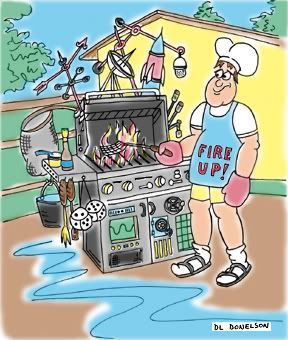
Outdoor cookery was born when some clumsy caveman accidentally dropped a hunk of brontosaurus into the campfire. After yelling and screaming at him for his fumble-fingered treatment of their dinner, his family’s response was probably, “Fire… Meat….Gooood!”
When the caveman moved to the suburbs, his campfire became a bowl-shaped charcoal grill standing on three wobbly legs. With luck, he could coax a pile of kerosene-soaked briquettes to cook a few hotdogs in no more than maybe thirty minutes. But, just as the caveman evolved into today’s investment banker, the barbeque grill grew up to become a $15,000 outdoor kitchen complete with wok and pizza stone, infrared burners, and a built-in refrigerator with beverage dispenser. The sink with hot and cold running water is extra.
The up-to-the minute outdoor chef can choose from several monster hibachis that will make him or her the envy of the neighborhood (although hopefully not the bane of the fire department). Today’s outdoor cooking centers have some remarkable features.
The first thing most discerning grillers look at is the size of the cooking surface. Most usually want nothing less than a grill that’s about thirty inches wide overall with close to 700 square-inches of total cooking area. A serious outdoor chef will opt for something larger, though. Freestanding models wider than sixty inches aren’t uncommon and built-ins apparently have an upper size limit just slightly smaller than an aircraft carrier.
Distribution and containment of the heat over the cooking surface is important, too, so many units now come with lined hoods that are almost sealed when they close. That can bring the internal temperature up to 800 degrees so you can toast your hamburger buns very, very fast.
Other new features include battery-powered or electrical igniters instead of the old-fashioned piezo, or clicking, igniter. Some models even have interior lights that only have to be cleaned every three or four uses. Most manufacturers offer an LP or natural gas option.
The infrared burner is a significant development in outdoor cookery. Some manufacturers build them in as part of the “cooking system” along with traditional burners, while others use infrared as their sole heat source. Traditional grills cook by convection: the burners heat up a secondary element (briquettes, lava rock, vaporizer plates or rods), which creates radiant energy and heated air. Infrared burners produce high temperatures through direct radiant energy. The food is directly heated because there are no secondary elements. The infrared burner produces intense heat that immediately sears the food, locking in moisture and flavor. The food cooks in its own juices in up to half the time needed by traditional grills.
But buying the base-model grill, like buying a new car, is just the start. All the top grill manufacturers offer numerous options and accessories for the griller who wants to have it all. One of the most interesting options is a built-in commercial-quality, all-weather refrigerator with wine cradles. The caveman may have stored his stegosaurus steak in a handy glacier, but the modern backyard chef can keep his in the fridge right under his grill. For serious partiers, some manufacturers also offer a built-in refrigerated beverage dispenser that comes complete with CO2 cylinder and keg coupler.
You can also add a wok to stir-fry like a pro. Or a griddle. Why go out to a restaurant for breakfast when you can cook eggs and pancakes in your backyard? Then there is the steamer for your vegetables or the deep fryer for your French fries. And don’t forget the wood chip smoker so your salmon filets can taste like they were cooked over an open flame (it’s a retro-caveman thing). You probably can’t do without a food warmer or a pizza stone. And you absolutely must have a motorized rotisserie—you can get one that handles thirty pounds of meat!
Fortunate is the family who has an outdoor cooking center (what the heck’s a grill, anyway?) and a fire-meister to cook on it. While the rest of us are indoors microwaving our TV dinners this summer, they’ll be outside enjoy grilled portabellas, rotisserie prime rib, crispy hash browns…or maybe seared tuna steaks with stir-fried vegetables…or smoked salmon pizza served with a freshly-drawn tap beer…or….
Fire…Meat…Gooood!
--Dave Donelson, author of Heart of DiamondsFriday, March 7, 2008
Free Book from Seth Harwood
If noir detectives are your thing, check out this free book--Jack Wakes Up--available from Seth Harwood. I think the offer is only good through Palm Sunday, though.
http://media.libsyn.com/media/sethharwood/JackWakesUp.pdf


 Posts
Posts


