Monday, April 30, 2012

Advice For Winning Golf From Danny Balin

Want to play like a winner? You'd be hard pressed to find someone better to emulate than Danny Balin, assistant pro at Burning Tree Country Club in Greenwich, and winner of the 2011 Lincoln Met PGA Championship. Balin was one of several panelists at this spring's Met PGA Best Practices Forum who had excellent advice for those of us who want to score better in tournament play--or anytime.

"During your practice rounds, spend 80% of your time on chipping and putting and 20% on everything else," Balin recommends. When it comes to putting, he suggest using a chalk line to help train your eyes and a tee gate made just wide enough for your putter to fit through to groove your stroke. He also only practices straight putts since playing a break starts by rolling the ball straight on the proper line. Finally, he reminds us to train our eyes to see the ball go into the hole. "Do your eyes focus on one target, or flit around?" he asks.

When it comes to course management, Balin says, "Par is a great score." He believes a big part of the mental game is understanding that fact and knowing when (and when NOT) to go pin hunting, be too aggressive, be too conservative. To help your mental game, Balin recommends reading books--not just about golf--dealing with training athletes' minds. One he favors is Mind Gym by Gary Mack.

Among many other books, Dave Donelson is the author of Weird Golf: 18 tales of fantastic, horrific, scientifically impossible, and morally reprehensible golf

Thursday, April 19, 2012

HR Pros Offer Advice At 914Inc Power Breakfast

I'll be moderating a panel of Human Resource professionals next week, addressing issues from how you should (and can) control your employee's social media usage to what will happen if the Supreme Court overturns the healthcare legislation--and what if it doesn't? The event is a 914Inc. Magazine's Power Breakfast to be held Tuesday, April 24, at 7:30 AM at the Doubletree Hotel in Tarrytown, NY.

Joining me on the panel are five experts who bring different viewpoints on these and other issues:

Susan Corcoran
Jackson Lewis (a labor and employment law firm)
White Plains

Greg Chartier
Principal, The Office of Gregory J Chartier
Chair of the Human Resources Council of the Westchester Business Council

Ann Henning
Human Resources Manager, Sprint

Edwin L. Bowman
Principal, BowmanBecker Consultancy, LLC
Past President, Westchester Human Resources Management Association

Joseph DiCarlo
Director of HR, WESTMED
Former VP of HR, Porter Novelli

Tickets are complementary, but seats are limited, so make your reservations today.

Dave Donelson distills the experiences of hundreds of entrepreneurs into practical advice for small business owners and managers in the Dynamic Manager's Guides, a series of how-to books about marketing and advertising, sales techniques, motivating personnel, financial management, and business strategy.

Sunday, April 15, 2012

Weird Golf Debuts On The Links

The first edition of my new golf anthology, WEIRD GOLF, is now available in all formats.

The subtitle tells it all: 18 tales of fantastic, horrific, scientifically impossible, and morally reprehensible golf.

It's available for Kindle, Nook, iPad, and other ebook readers and a trade paperback edition was released Friday.

Dave Donelson distills the experiences of hundreds of entrepreneurs into practical advice for small business owners and managers in the Dynamic Manager's Guides, a series of how-to books about marketing and advertising, sales techniques, motivating personnel, financial management, and business strategy.

Tuesday, April 3, 2012

Negotiating With Honor

How do you negotiate honorably and successfully? By negotiating both value and price with the goal of striking the most favorable deal for both the buyer and the seller. If there is a morality problem with a negotiated sale, it’s when one party’s aim is to “win” the game at the expense of the other. If both the buyer and the seller can believe in and practice win/win negotiations, everybody’s life is easier and they can sleep better at night.

Unfortunately, too many people engage in win/lose negotiation. They believe that the only way they can gain value is by taking it away from the other person. They view every transaction as a zero-sum game. This belief is anathema to the Creative Selling System. You can’t build long term customer relationships based on taking advantage of the customer every time you sell them something. Sooner or later they’ll figure it out.

When you engage in win/lose negotiation, you create an adversarial relationship with your prospect. That lifeblood of Creative Selling, information about the prospect’s needs, is cut off at the source because the prospect soon realizes that you’re using that information to gain the upper hand in the negotiations.

That’s one of the main reasons, by the way, that the traditional consultive selling approach is so ineffective—many prospects fear that giving information to the consultive seller will just give him ammunition to use in future negotiations. So they clam up or even give misleading information to confuse the seller.

You can’t create solutions to the prospect’s needs unless you learn what those needs are. Without that information, your selling effort degenerates into a guessing game where you have to keep offering different proposals without having the feedback necessary to come up with good ones. And because your ideas don’t very accurately meet the prospect’s needs, fewer sales occur. The win/lose negotiation attitude may produce a larger single order today, but it reduces the probability of getting better orders tomorrow.

Dave Donelson distills the experiences of hundreds of entrepreneurs into practical advice for small business owners and managers in the Dynamic Manager's Guides, a series of how-to books about marketing and advertising, sales techniques, motivating personnel, financial management, and business strategy.

Tuesday, March 27, 2012

A Customer-Friendly Retail Environment

We sometimes fool ourselves into thinking that people are so used to shopping unaided in the aisles of mass-market retailers that they don’t want to be bothered by pesky sales people, but nothing could be further from the truth. What customers don’t like is a clerk hanging around putting silent pressure on them to make a decision. While there may be a few independent souls who want to browse unaided through a plan-o-gram full of merchandise, most people appreciate the expert advice and guidance of a knowledgeable retail sales person, especially when they’re shopping for something more complicated than a bottle of shampoo.

A good retail salesperson does their best work when they help a customer figure out what they need in order to accomplish their goal or fix their problem. Which means, of course, that your staff has to know what they’re talking about. They need to know the lines you carry and what the products do—and don’t do. They need to be able to answer the prospect’s questions and even to suggest questions that the prospect should be asking. If they don’t know the answers, they should know where and how to get them—and make it clear to the customer that they’re willing to do the extra work cheerfully.

Helpful service like this means the sales person needs another set of tools, too: good communication skills. Sometimes, it’s not enough to just ask the customer what he wants. The sales person may need to do a little probing about the customer’s needs or desires before he or she can suggest a good solution. They need to know what kinds of questions to ask and—even more importantly—they need to listen to the answers. Some customers will be able to tell you exactly what they’re looking for, what size they want, and even where it’s located in your inventory. A far greater majority of them, though, are like patients in the doctor’s office; they need somebody to listen to their symptoms, to tell them why it hurts, and to prescribe something they can do about it.

Dave Donelson distills the experiences of hundreds of entrepreneurs into practical advice for small business owners and managers in the Dynamic Manager's Guides, a series of how-to books about marketing and advertising, sales techniques, motivating personnel, financial management, and business strategy.

Tuesday, March 20, 2012

Negotiating In The Retail Store

Helpful negotiation tactics for retail salespeople:

● Stay cool. If a customer asks for a lower price, remember that it’s just a business transaction, not a judgmental comment on your artwork, your gallery, or you.

● Know your limits, but don’t go there right away. If the customer can talk you into two small concessions rather than one big one, they’re more likely to be satisfied with the deal.

● Ask for something in return. A customer may be willing to use cash rather than a credit card, put their name on your mailing list, or give you something else of value in return for a lower price.

● Use negotiation to close the sale. “If I give you this price, will you buy it now?” is a great way to separate buyers from lookers.

In today’s economy, you can expect more and more retail customers to test the firmness of your prices. If you keep your wits about you and exclude emotions from the process, though, you can use that trend to build your sales.

Dave Donelson distills the experiences of hundreds of entrepreneurs into practical advice for small business owners and managers in the Dynamic Manager's Guides, a series of how-to books about marketing and advertising, sales techniques, motivating personnel, financial management, and business strategy.

Tuesday, March 13, 2012

Taking Stress Out Of Negotiations

Negotiating has earned its reputation as an unpleasant process in large part because it is inherently stressful. Stress is produced when something or someone blocks a person from obtaining a desired goal, which just about defines the process of negotiation. Each party is blocking the other one in some way. “I won’t buy unless you give me this” is just another way of saying, “You can’t obtain your goal (to get the order) because my demand (to get the concession) is blocking your way.”

Two other stressful things happen in negotiation. The blocks generally get bigger and bigger as the easy concessions are made early and the tough ones—the big price cut or the large volume order—are left to the end. And, the closer you get to the end, the closer each person feels to achieving his or her goal. The carrot is dangled closer and closer to the donkey’s nose.

Stress, stress, stress. That’s the real reason many people feel uncomfortable when put into a negotiating role. The uncertainty of the outcome is stressful. The pressure to make multiple decisions is stressful. The fear of feeling outfoxed is very stressful. It’s certainly a lot less stressful to say, “Sorry, our prices are firm. Take it or leave it.” You get the pain over with.

Negotiation doesn’t have to be that way. I’m not saying that you’ll eliminate the uncertainty, the decision-making, or the possibility of leaving some money on the table, but you can make the process less stressful if you have the right attitude.

The better way, of course, is win/win negotiation, where both parties recognize that the value side of the equation is not finite. If you can focus on building the value of the deal, both the buyer and the seller generally win. Win/win negotiation is at the heart of the Creative Selling System because it focuses on need satisfaction.

Dave Donelson distills the experiences of hundreds of entrepreneurs into practical advice for small business owners and managers in the Dynamic Manager's Guides, a series of how-to books about marketing and advertising, sales techniques, motivating personnel, financial management, and business strategy.

Sunday, March 4, 2012

Free Books To Celebrate Read An eBook Week

Celebrate Read An eBook Week with 50% off all my full-length books at Smashwords.com. Enjoy any (or all!) of my novels and Dynamic Manager books by using this coupon code when you check out: REW50. Hurry, the sale ends March 10!

Heart Of Diamonds: a novel of scandal, love, and death in the Congo

Hunting Elf, a doggone Christmas story

The Dynamic Manager's Guide To Advertising: How To Grow Your Business With Ads That Work
The Dynamic Manager’s Guide To Marketing: How To Create And Nurture Your Best Customers
The Dynamic Manager’s Guide To Marketing & Advertising: How To Grow Sales And Boost Your Profits (includes both advertising and marketing books)

The Dynamic Manager’s Guide To Sales Techniques: How To Create New Prospects And Make More Sales
The Dynamic Manager's Guide To More Sales: How To Nurture Customers And Grow Your Business
The Dynamic Manager's Guide To Creative Selling: How To Make More Sales And Build A Super Sales Career (includes both sales books)

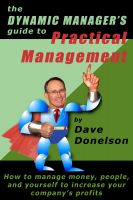
The Dynamic Manager’s Guide To Practical Management: How To Manage Money, People, And Yourself To Increase Your Company’s Profits

As a special bonus, Blind Curve, my collection of short stories, is available this week for free! Just use coupon code REW100.

Check out the thousands of other titles available with big savings at Smashwords.com through March 10. You'll find eBooks for all reading devices--Kindle, Nook, iPad, and others.

Dave Donelson distills the experiences of hundreds of entrepreneurs into practical advice for small business owners and managers in the Dynamic Manager's Guides, a series of how-to books about marketing and advertising, sales techniques, motivating personnel, financial management, and business strategy.

Tuesday, February 28, 2012

Negotiating Like A Pro

Do customers in your industry pay the asking price? Or do they routinely ask for a lower price, better terms, extra merchandise, rebates, slotting fees, or extended service? If you sell business-to-business, you’ve probably never had a customer agree to pay your asking price on the first pass. It’s becoming more common in retail sales, too. What your customers are doing, of course, is practicing an art as old as commerce itself. They’re negotiating.

Negotiation is that stage of the selling process that occurs after the commitment to buy is made but before the sale is actually closed. It’s when the buyer and seller come to terms on the conditions under which the product or service is provided.

Sounds imposing, doesn’t it? And it can be a complicated undertaking, which is why I suggest you approach negotiations as carefully as James Cameron approached the production of Avatar. You need to coordinate all the various components of the negotiation if you are going to produce a successfully orchestrated sale.

Negotiation is a matter of choices by both parties. One party chooses whether or not to offer something and the other one chooses whether or not to accept it. As you’ll see, it’s not always the seller who does the offering, nor is it always the buyer who does the accepting or rejecting. Nor is price the only item subject to negotiation.

When do you negotiate? If you’re a creative seller, you only negotiate the terms of your proposal after the prospect has made the commitment to buy the idea you are selling. If the prospect doesn’t like the idea, no amount of negotiation of the price or any of the other terms will make the sale happen. But once that commitment is made, you can assume that you will negotiate the sale in one way or another.

The price to value ratio is at the heart of every negotiation. Both the buyer and the seller negotiate both sides of that equation, giving gains on one side in return for gains on the other. When the needs of both the buyer and seller are met, the sale occurs.

Dave Donelson distills the experiences of hundreds of entrepreneurs into practical advice for small business owners and managers in the Dynamic Manager's Guides, a series of how-to books about marketing and advertising, sales techniques, motivating personnel, financial management, and business strategy.

Tuesday, February 21, 2012

Effective Team Sales Presentations

Each team, even if it consists of only two members, should have a leader. That’s usually the senior person on the team and will be the person the prospect will tend to address with questions. It doesn’t have to be, but it usually happens that way. The leader will also generally be the one to open the presentation and ask the closing question. If there is any question about who’s going to be the leader on your team, settle it before you go into the presentation.

But don’t let the leader look like the Grand Poobah attended by his retinue. If the leader delegates all the menial tasks like handing out materials to the lowly lackeys on the team, the prospect is liable to sense a power display in progress, and react negatively. Eliminate this problem before it arises and make sure the leader is perceived as a member of the team, not its monarch.

On the other end of the scale, also make sure that every member of the team actively participates in the presentation. Each person should have a speaking role of some sort, preferably related to their role in the seller’s plan to serve the prospect’s needs. You don’t want the prospect wondering why that guy in the corner isn’t saying anything while you’re trying to make the points in your presentation. The Metropolitan Opera may need spear-carriers, but your sales team doesn’t.

In order to keep your team call focused on results, make sure everyone on the team understands these points about the upcoming call:

What are we trying to do?
If this call is successful, what will happen?
Who are the key players?
What happened on the last call?
What are we going to ask them to do?
Why should they do it?
The choir always sounds better when they’re all singing the same song.

Dave Donelson distills the experiences of hundreds of entrepreneurs into practical advice for small business owners and managers in the Dynamic Manager's Guides, a series of how-to books about marketing and advertising, sales techniques, motivating personnel, financial management, and business strategy.